
Resources
How to Determine Your Model A Ford Rear-End Ratio
A hands-on method to learn what is under your Model A—no differential teardown, no guesswork when you configure A-Speed, or just want to know.
Introduction
Plenty of Model A Ford owners inherit a car whose rear-end ratio is unknown—or assume the standard 3.78:1 when something else is installed. That matters when you dial in A-Speed: the app's RPM calculator uses your rear-end ratio, tire diameter, and shift points to estimate engine speed out on the road.
The good news is you can identify the ratio with a simple rolling test in your driveway or garage. You never need to open up the differential or count ring-gear teeth through the fill hole.
Why Rear-End Ratio Matters
The rear-end ratio describes how many times the driveshaft—and therefore the engine—turns for each revolution of the rear wheels. Change the ratio and you change how hard the engine works at any given road speed.
- Engine RPM: A taller ratio (higher number) spins the engine faster at the same MPH.
- Touring comfort: Matching your actual gearing helps you choose shift points and cruising speeds that feel right and protect your engine.
- Speedometer accuracy: GPS speed in A-Speed is independent of gearing, but RPM estimates depend on it.
- Fuel economy: Honest MPG tracking is easier when RPM and speed readings reflect what the car is actually doing.
- A-Speed RPM calculations: Enter the correct ratio in Settings and the RPM calculator becomes noticeably more trustworthy at cruise—especially with overdrive configured.
Tools & Preparation
Gather a few simple items before you start:
- A flat, level stretch with several feet of clear space ahead
- Chalk, tape, or a washable marker
- Wheel chocks for the front wheels (recommended)
- A helper to push while you watch the crank pulley
Prepare the car:
- Shift the transmission into high gear
- Remove all four spark plugs so the engine turns freely
- Block the front wheels if you are on even a slight grade
Marking the Vehicle
Place two reference marks before anyone pushes:
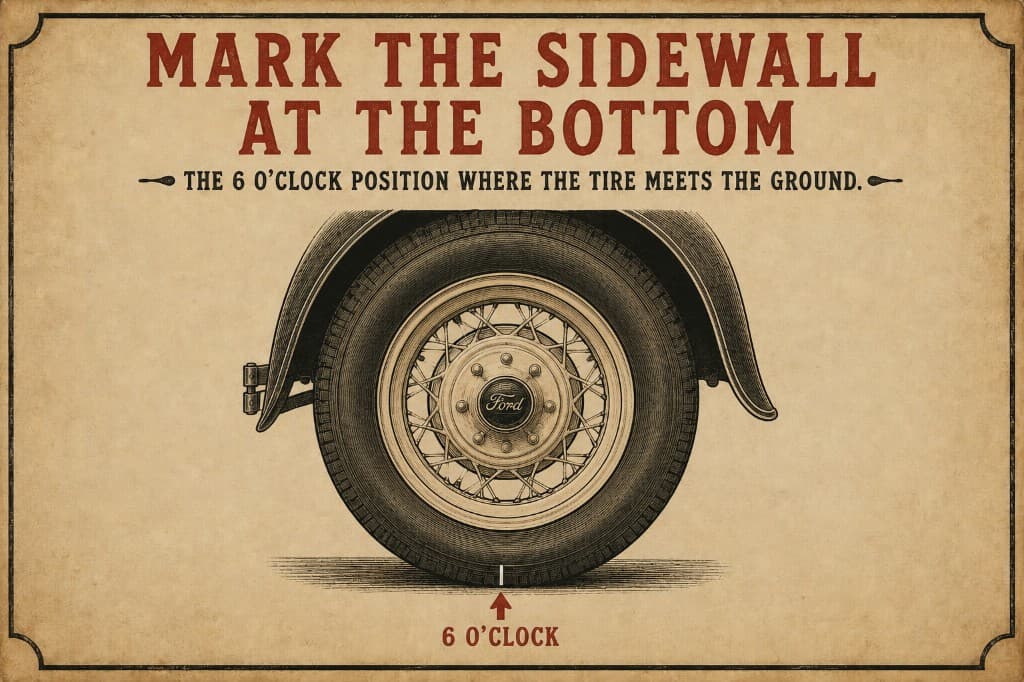
- Rear tire:Mark the sidewall at the bottom—the 6 o'clock position where the tire meets the ground. Use chalk or a piece of masking tape.
- Crank pulley:Mark the rim at the top—the 12 o'clock position on the front crank pulley. If you have a TDC mark already, you can crank the engine to TDC and use that mark.
These marks are your start and finish lines. You will count how far the pulley turns while the tire makes exactly one full rotation.
Rolling the Vehicle
With the car in 3rd gear (NO OVERDRIVE) and your helper slowly pushing the car straight forward, watch the crank pulley mark. Count each full revolution of the pulley as the car moves.
Stop the moment the tire mark returns to its starting position at the bottom of the wheel—one complete tire revolution. Note both the number of full pulley turns and where the pulley mark ends up on its final partial rotation.
Move smoothly and steadily. A jerky push makes the final position harder to read.
Interpreting the Results
For most Model A rear-end ratios, the crank pulley completes slightly more than three full revolutions during one tire turn. The stopping point of the pulley mark on that last partial turn is what identifies the ratio.
Think of the pulley face like a clock: compare where your mark lands after the tire finishes its rotation to the reference positions in the guide below. If you are between two marks, your ratio likely falls between those values.
Ratio Reference Guide
Use this crank pulley chart to match your result. Each ratio shows roughly how many turns the pulley makes for one rear tire revolution, and where the mark typically stops.
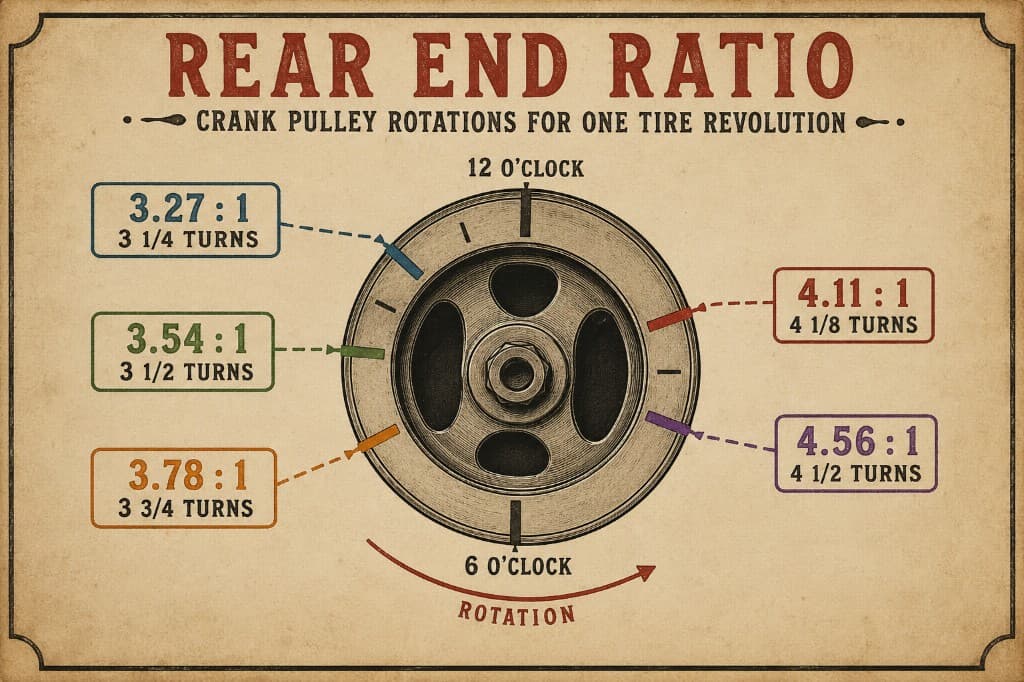
3.27:1
About 3¼ crank pulley revolutions
A lower numeric ratio—fewer engine turns per tire rotation. Often chosen for relaxed highway cruising when gearing allows.
3.54:1
About 3½ crank pulley revolutions
A common aftermarket-friendly ratio. The pulley mark typically finishes near the 9 o'clock position after one tire revolution.
3.78:1
About 3¾ crank pulley revolutions
The standard ratio for many Model A setups. Expect the pulley mark to land in the lower-left quadrant when the tire finishes its rotation.
4.11:1
About 4⅛ crank pulley revolutions
A taller ratio that turns the engine more per mile—useful for hill-climbing torque but higher RPM at a given road speed.
Using Your Ratio in A-Speed
Once you know your rear-end ratio, open A-Speed Settings and enter it under drivetrain configuration. A-Speed includes presets for common Model A ratios (3.54, 3.78, and 4.11), or you can type a custom value.
Pair the ratio with an accurate tire diameter and your shift points, then check the RPM Chart in Settings at a few cruise speeds. Your touring RPM calculator should now track much closer to what you feel on the road—especially helpful when judging overdrive engagement on highway legs.
Related Resources
- Timing the Model A Ford Engine → — Set basic Model A ignition timing with the timing pin, point gap, and distributor cam adjustment.
- How Accurate Is Your Model A Ford Speedometer? → — Learn why vintage speedometers drift and how to test yours against GPS for honest touring speeds.
- How to Calculate Model A Ford Engine RPM → — Understand the math behind MPH, tire size, and rear-end ratio—and see example RPM figures for real Model A setups.
- Understanding Model A Ford Overdrive Ratios → — Learn how overdrive affects RPM, cruising speed, and drivability—and how common Mitchell, Borg-Warner, RTS, and T5 conversions fit touring builds.
- How to Measure Tire Diameter for Accurate Model A Ford RPM Calculations → — Measure tire diameter the right way—direct and rolling methods, wear considerations, and why accurate sizing matters for A-Speed RPM on tour.
- A-Speed Features → — GPS speedometer, RPM calculator, and touring tools
- Help & FAQ → — Setup, drivetrain settings, and troubleshooting
- User Guide PDF → — Complete A-Speed reference for Model A owners